
Dermarolling with Minoxidil: The Protocol Guide
Written by the Balding AI Editorial Team, medically reviewed by Dr. Nga Nguyen (Dermatologist), grounded in AAD and NHS clinical guidelines. Tracking guidance, not medical advice or diagnosis.
Jump to sections
In 2013, a team led by Rachita Dhurat at the Lokmanya Tilak Municipal Medical College in Mumbai published a study that reshaped how dermatologists think about minoxidil. The trial split 100 men with mild-to-moderate androgenetic alopecia into two groups. Group A applied 5% minoxidil twice daily. Group B did the same, plus weekly microneedling sessions at 1.5mm depth. After 12 weeks, Group B had a mean hair count increase of 91.4 hairs per square centimeter. Group A managed 22.2. That's a 4.1x improvement from adding a single weekly procedure. The paper, published in the International Journal of Trichology, has since become the most cited study in the microneedling-for-hair-loss literature.
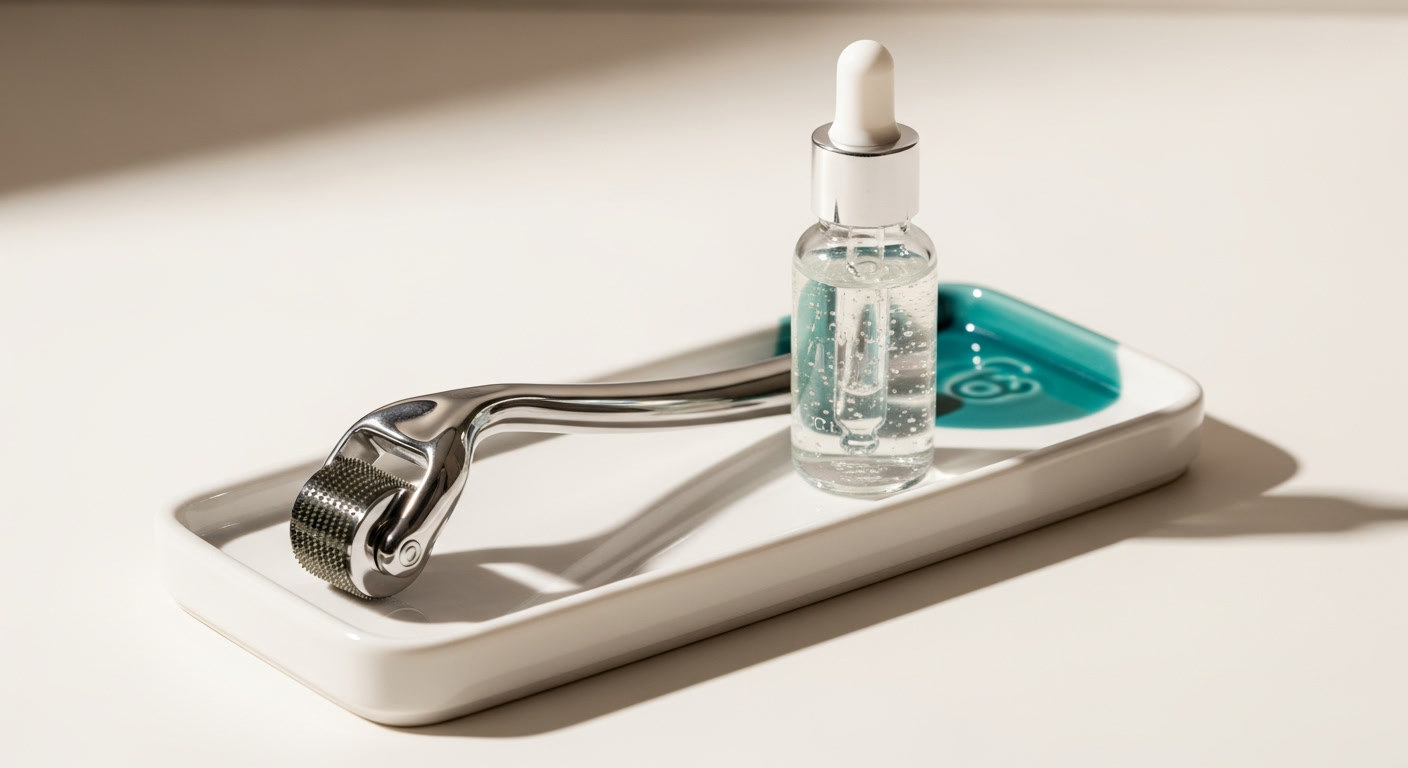
The study that proved the combo works
The Dhurat et al. (2013) study in the International Journal of Trichology enrolled 100 men between ages 20 and 35 with grade II to IV androgenetic alopecia on the Norwood-Hamilton scale. Both groups applied 5% topical minoxidil lotion twice daily. Group B also received weekly microneedling using a dermaroller with 1.5mm needles, applied under topical anesthesia in a clinical setting. The primary endpoint was change in hair count from baseline, assessed via phototrichographic analysis.
At 12 weeks, Group B (microneedling + minoxidil) achieved a mean hair count increase of 91.4 per cm² compared to 22.2 per cm² in Group A (minoxidil alone). The difference was statistically significant (p < 0.005). Perhaps more telling: 82% of participants in the microneedling group reported more than 50% improvement on a patient assessment scale, versus just 4.5% in the minoxidil-only group. The combination wasn't marginally better. It was categorically different.
Subsequent research has reinforced these findings. Fertig et al. (2018) demonstrated that microneedling improved outcomes in patients who had previously plateaued on minoxidil alone. Kumar et al. (2018) confirmed the synergistic effect across a broader patient population. The evidence base is now strong enough that many hair restoration clinics incorporate microneedling as a standard adjunct to topical treatment.
Track your microneedling + minoxidil protocol from day one
BaldingAI gives you consistent photo captures with guided angles and session logging so you can measure whether the combined protocol is working over 3, 6, and 12 months.
Use the BaldingAI hair tracking app to save one baseline session now, compare monthly checkpoints later, and keep one clear record for your next treatment or dermatologist decision.
Take one baseline session today. You cannot go back and capture last month, and the comparison you will want in three months only exists if today is in it.
Why microneedling supercharges minoxidil
The combination works through three distinct biological mechanisms, each independently documented in the literature.
Wound healing cascade and growth factor release. Microneedling creates controlled micro-injuries in the scalp. The wound healing response that follows releases platelet-derived growth factor (PDGF), fibroblast growth factor (FGF), and vascular endothelial growth factor (VEGF). These signaling molecules stimulate the dermal papilla cells that control hair follicle cycling. VEGF in particular promotes angiogenesis around the follicle, improving blood supply and nutrient delivery to the hair matrix.
Enhanced topical absorption. The microchannels created by needling allow minoxidil to penetrate deeper into the dermis, bypassing the stratum corneum barrier that normally limits absorption. This means more active compound reaches the follicular target. The enhanced permeability persists for hours to days after the needling session, though applying minoxidil immediately after is not recommended for safety reasons discussed below.
Wnt/beta-catenin pathway activation. Kim et al. (2016) published in the Journal of Dermatological Science that microneedling activates the Wnt/beta-catenin signaling pathway, which plays a central role in hair follicle morphogenesis and cycling. This pathway promotes follicle neogenesis, the formation of new hair follicles from stem cells. It also helps transition dormant follicles from the telogen (resting) phase back into anagen (growth). This mechanism may explain why microneedling appears to reactivate follicles that stopped responding to minoxidil alone.
The exact protocol: depth, device, and frequency
Needle depth. The Dhurat study used 1.5mm, and that remains the best-supported depth for hair regrowth. At 1.5mm, the needles reach the upper dermis where the dermal papilla cells reside, triggering the full wound healing cascade. A depth of 1.0mm provides a meaningful growth factor response while causing less discomfort and is a reasonable starting point for beginners. Depths below 0.5mm are useful for skincare but do not penetrate deep enough to significantly affect hair follicles.
Device choice. The original study used a manual dermaroller (a cylindrical drum studded with needles). Dermarollers are inexpensive and widely available, but the rolling motion means needles enter and exit the skin at an angle, which creates slightly larger wounds and can cause more irritation. A dermapen (motorized pen device) drives needles straight in and out vertically. This provides more consistent depth, less surface trauma, and better control over difficult areas like the temples and hairline. If budget allows, a dermapen is the better tool. If you use a dermaroller, roll in multiple directions (horizontal, vertical, diagonal) with moderate pressure across each treatment zone.
Frequency. Once per week, maximum. This is not a more-is-better situation. The scalp needs 5 to 7 days to complete its wound healing cycle after a 1.5mm session. Needling more frequently interrupts that cycle and creates chronic inflammation rather than the acute healing response you want. Chronic scalp inflammation is associated with accelerated hair loss, not improvement. Some protocols use once every 10 to 14 days, which also works. The key constraint is full healing between sessions.
Timing: when to apply minoxidil after needling
This is the most common mistake in the combined protocol. Do not apply minoxidil immediately after microneedling. Wait a minimum of 12 hours. Many dermatologists recommend 24 hours.
There are two reasons. First, applying minoxidil to freshly needled skin dramatically increases systemic absorption. Minoxidil is a vasodilator originally developed as a blood pressure medication. Increased systemic uptake raises the risk of cardiovascular side effects including dizziness, heart palpitations, and fluid retention. The channels created by microneedling bypass the skin's normal rate-limiting barrier, and the result is a dose-response profile that no clinical trial has tested for safety.
Second, the stinging and irritation from applying an alcohol-based solution to an open wound bed is significant. It hurts, it causes excessive redness, and it reduces compliance. People who experience pain after their needling session are more likely to skip sessions or reduce frequency, which undermines the protocol.
The practical approach: do your microneedling session in the evening. Skip that night's minoxidil application. Resume your normal twice-daily minoxidil schedule the following morning. The enhanced absorption benefit from microneedling persists for days after the session, not just hours, so you are not losing efficacy by waiting. You are gaining safety and comfort.
Safety and hygiene
Clean your device with 70% isopropyl alcohol before and after every session. Submerge the needle cartridge (dermapen) or roller head (dermaroller) for at least 60 seconds, then let it air dry completely. Some users also rinse with hydrogen peroxide as a secondary disinfection step. Never use a device that has visible debris or corrosion on the needles.
Replace your needles regularly. Dermaroller needles dull after 4 to 6 uses. A dull needle tears the skin rather than puncturing it cleanly, which increases surface trauma, bleeding, and infection risk without improving the wound healing response. Dermapen cartridges should be replaced after every 1 to 3 sessions depending on the manufacturer's guidance. The cost of replacement cartridges is negligible compared to the cost of a scalp infection.
Do not microneedle over active acne, seborrheic dermatitis, open wounds, sunburned skin, or any area showing signs of infection. If you develop persistent redness lasting more than 48 hours, unusual swelling, pus, or warmth at the treatment site, stop needling and see a dermatologist. These are signs of infection or an abnormal inflammatory response that requires medical evaluation. Never share your microneedling device with anyone. Bloodborne pathogen transmission is a real risk with shared sharps.
The realistic results timeline
Month 1 to 2. You may notice reduced daily shedding as the growth factor stimulus begins shifting follicles toward anagen. Your scalp will be tender for 24 to 48 hours after each session, and you may see mild redness and pinpoint bleeding during the procedure itself. These are normal and expected. Some people experience a brief shedding phase as dormant follicles cycle in response to the new stimulus. This is analogous to minoxidil shedding and is generally a positive sign.
Month 2 to 4. This is when the earliest visible changes typically appear. Fine, short vellus hairs (baby hairs) may become visible in areas where the scalp was previously bare or thin. These are new hairs entering the growth phase. They will be thin and light-colored at first and will need several more growth cycles to reach terminal thickness. Photo comparisons against your baseline become meaningful around the 12-week mark, consistent with the Dhurat study's primary endpoint.
Month 4 to 6. Noticeable density improvement in responding areas. The vellus hairs from earlier months are thickening. Scalp visibility through the hair decreases. This is the window where most people can see a clear difference in matched before-and-after photos. Non-responders also become identifiable at this stage: if there is no change at all by month 6 with consistent protocol adherence, the combination may not be effective for your pattern of loss.
Month 6 to 12. Full treatment effect realized. Hair that began as vellus at month 3 has had time to undergo multiple growth cycles and approach terminal quality. Density and coverage improvements stabilize. The Dhurat study demonstrated significant results at 12 weeks, but maximum benefit from any hair loss treatment generally requires 12 months of sustained use. Continue the protocol at maintenance frequency and reassess annually.
How to track your combined protocol
Tracking a combined protocol requires logging both variables separately and capturing visual evidence consistently. Without this structure, you cannot distinguish between a protocol that isn't working and a protocol that isn't being followed.
Log each microneedling session. Record the date, needle depth, device used, areas treated, and any observations (bleeding level, pain level, unusual reactions). This session log becomes essential if you need to troubleshoot later. A gap in sessions or an unrecorded depth change can explain a plateau that would otherwise look like treatment failure.
Track minoxidil compliance separately. Note each application (morning and evening). Track skipped applications and the reason. If you miss the evening dose after a needling session, that's planned and expected. If you miss three days because you traveled without your bottle, that affects your results and needs to be in the record. Aiming for 90% or higher compliance over any given month is a reasonable target.
Take weekly photos with fixed conditions. Same lighting, same distance, same angles, same hair state (wet or dry, but always the same). Focus on the specific areas you are needling. Front hairline, temples at 45 degrees, crown from directly above. Weekly photos feel excessive until you try to compare month 0 to month 6 and realize you need intermediate frames to confirm the trend is real and not an artifact of a single good or bad hair day.
Review at structured intervals. Compare photos at baseline, month 3, month 6, and month 12. These are your formal checkpoints. Resist the urge to compare weekly photos against baseline looking for transformation. Weekly variation is noise. Monthly checkpoints are signal. If you see no improvement by month 6 with 90% or higher compliance on both microneedling and minoxidil, reassess your needle depth, your technique, and your expectations before abandoning the protocol entirely. If compliance has been inconsistent, fix the process before changing the treatment.
Note side effects. Track post-session irritation levels, any increased shedding in the days following needling, and any systemic effects from minoxidil (dizziness, scalp itching, unwanted facial hair growth). This record protects you by creating a timeline that a dermatologist can use to adjust your protocol if needed. Systematic tracking turns a vague feeling of "something isn't right" into actionable clinical data.
What this guide helps you decide
Follow the evidence-based microneedling + minoxidil protocol and track your combined results
Best for readers already running a plan and trying to keep month-level reviews interpretable.
Use This Guide Well
For treatment tracking content, interpretation depends on month-over-month direction and adherence context, not isolated day-level snapshots.
- Keep capture conditions fixed across all weekly sessions.
- Log adherence and routine changes immediately after each capture.
- Run a monthly decision review with trend snapshots and notes.
Safety note
This article is for education and tracking guidance. It does not replace diagnosis or treatment advice from a licensed clinician.
- Use matched photo conditions whenever possible.
- Review monthly trends instead of reacting to one photo day.
- Escalate persistent uncertainty or symptoms to clinician care.
Questions and Source Notes
Turn this tracking plan into a real system
Balding AI helps you keep every scan comparable, review month-level direction faster, and stop making decisions from random photo days.


Keep Reading From Here
Continue with the next article or matching tracking route that keeps this guide actionable instead of sending you back into broad browsing.
Next editorial reads
Topical Minoxidil First 90 Days: What to Track Week by Week
Foundational Guide · implementation
The Mediterranean Diet and Hair Growth: What the Research Shows
Foundational Guide · implementation
Tracking Hair Gains in Year 2: The Maintenance Plateau
Foundational Guide · implementation
Finasteride First 90 Days: What to Track Week by Week
Foundational Guide · implementation