
Does Biotin Help Hair Loss? What Research Shows
Written by the Balding AI Editorial Team, medically reviewed by Dr. Nga Nguyen (Dermatologist), grounded in AAD and NHS clinical guidelines. Tracking guidance, not medical advice or diagnosis.
Jump to sections
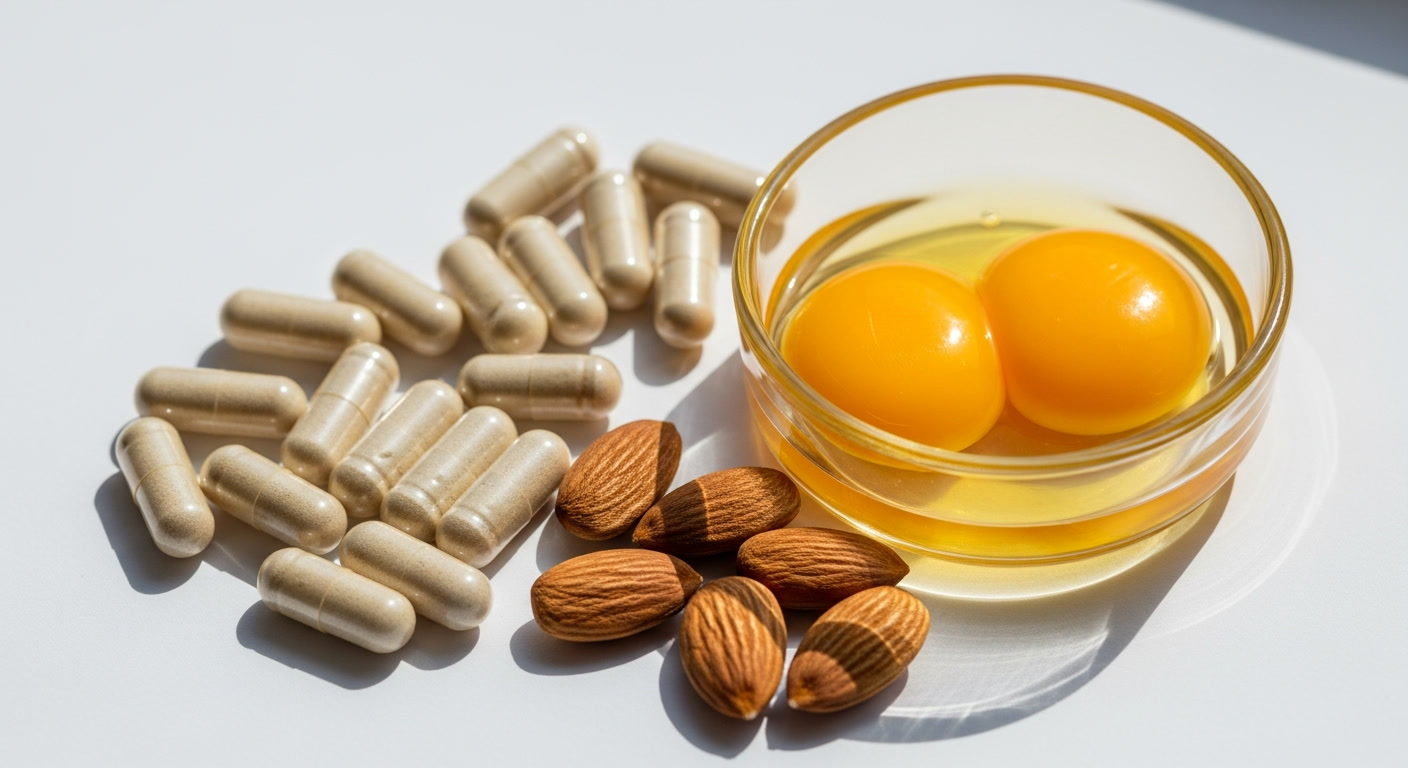
Biotin (vitamin B7) is the single most common ingredient in hair growth supplements. Walk into any pharmacy and you will find bottles promising thicker, stronger hair with 5,000 or 10,000 mcg of biotin per capsule. The recommended daily adequate intake is 30 mcg. That is a 166x to 333x markup over what your body actually needs. And yet, no randomized controlled trial has demonstrated that biotin supplementation improves hair in adults who are not deficient. Here is what the research actually shows.
Track your supplement results with real data
BaldingAI gives you consistent photo captures, monthly checkpoint comparisons, and density scoring so you know within 6 months whether biotin or any supplement is actually changing your hair.
Use the BaldingAI hair tracking app to save one baseline session now, compare monthly checkpoints later, and keep one clear record for your next treatment or dermatologist decision.
Take one baseline session today. You cannot go back and capture last month, and the comparison you will want in three months only exists if today is in it.
The biotin marketing machine
The global hair supplement market is projected to exceed $3 billion by 2028. Biotin sits at the center of nearly every product in this category. It appears in standalone supplements, multivitamins, gummies, shampoos, and conditioners. The marketing message is always the same: biotin supports keratin production, keratin is the protein your hair is made of, therefore more biotin means more hair.
That logic contains a critical gap. Your body does use biotin-dependent enzymes to synthesize keratin. But the amount of biotin required for this process is tiny. The National Institutes of Health sets the adequate intake at just 30 mcg per day for adults. Most people eating a standard diet consume 35 to 70 mcg daily from foods like eggs, salmon, nuts, seeds, sweet potatoes, and spinach. Deficiency in a person eating regular meals is genuinely uncommon.
Supplement companies are not required to prove that their products improve hair growth. They only need to avoid making explicit disease claims. Phrases like "supports healthy hair" and "promotes hair vitality" are structure-function claims that require no clinical evidence. This is why so many biotin products exist despite so little proof that they work for most buyers.
What biotin actually does in your body
Biotin is a water-soluble B vitamin that serves as a coenzyme for five carboxylase enzymes. These enzymes are involved in fatty acid synthesis, amino acid metabolism, and gluconeogenesis. Without adequate biotin, these metabolic pathways slow down. One downstream effect is impaired keratin production, since the amino acid building blocks of keratin depend on biotin-mediated metabolic steps.
Here is the key distinction that supplement marketing ignores: there is a massive difference between "biotin is necessary for hair protein synthesis" and "extra biotin improves hair growth." Water is necessary for every biological process in your body. Drinking ten times the recommended amount does not make those processes work ten times better. The same principle applies to biotin. Once your enzymes have enough cofactor to function at full capacity, additional biotin provides no incremental benefit. Your body excretes the excess in urine.
This is well established in biochemistry. Biotin-dependent carboxylases reach saturation at physiological concentrations. Flooding the system with 5,000 mcg when 30 mcg is sufficient does not accelerate keratin production. It simply produces expensive urine.
When biotin deficiency actually causes hair loss
True biotin deficiency exists, and when it occurs, it does cause hair problems. The classic presentation includes brittle nails, a scaly red rash around the eyes, nose, and mouth, and diffuse hair thinning. Patel et al. published a comprehensive review in Skin Appendage Disorders in 2017 documenting this clinical picture and the populations at highest risk.
The groups most vulnerable to biotin deficiency are specific. People who consume large amounts of raw egg whites ingest avidin, a glycoprotein that binds biotin tightly and prevents its absorption. Cooking denatures avidin, so cooked eggs are not a concern. Long-term antibiotic use can disrupt gut bacteria that produce biotin endogenously. Certain anticonvulsant medications, particularly carbamazepine and phenytoin, accelerate biotin catabolism. Chronic alcoholism depletes biotin stores through impaired absorption and increased urinary excretion. And genetic biotinidase deficiency, typically diagnosed in infancy, prevents the body from recycling biotin from dietary protein.
If none of those risk factors apply to you, your probability of being biotin deficient is very low. Population-level data from developed countries consistently show that acquired biotin deficiency is rare in adults eating varied diets. This is why blanket biotin supplementation produces such disappointing results for most people.
What clinical trials actually show
The studies most frequently cited to support biotin for hair loss have a consistent limitation: they tested multi-ingredient supplements, not biotin alone. Ablon (2015) in the Journal of Clinical and Aesthetic Dermatology studied a marine protein supplement that contained biotin alongside zinc, vitamin C, horsetail extract, and a proprietary blend. The study found improvements in hair growth, but isolating biotin's individual contribution is impossible when five other active ingredients are present.
Glynis (2012) in the Journal of Clinical and Aesthetic Dermatology reported similar findings with another multi-ingredient oral supplement. Again, biotin was one component among many. The study showed increased hair growth and reduced shedding in women, but the formulation also contained vitamin C, niacin, zinc, and a marine complex. Attributing the results specifically to biotin is scientifically unsound.
Weyand and Mahalingam (2016) published an analysis identifying this exact evidence gap. No randomized controlled trial has tested biotin as a sole intervention in non-deficient adults and demonstrated meaningful improvement in hair density, thickness, or shedding rates. The evidence base for the most popular hair supplement on the market is, when scrutinized, remarkably thin.
This does not mean biotin never helps. In the subset of people who are genuinely deficient, supplementation corrects the underlying metabolic bottleneck and hair quality improves. Trüeb (2016) in Skin Appendage Disorders found that 38% of women presenting with hair loss complaints had low biotin levels. For those women, supplementation made a real difference. For the other 62%, it did not.
The lab test interference problem
Beyond wasting money, high-dose biotin supplementation carries a real clinical risk that most consumers are unaware of. Biotin at the doses found in common supplements (5,000 to 10,000 mcg) interferes with immunoassay-based laboratory tests. These are the tests that measure troponin (heart attack marker), TSH (thyroid function), free T4, and several other critical biomarkers.
The interference occurs because many immunoassays use streptavidin-biotin binding as part of their detection chemistry. When excess biotin circulates in your blood, it competes with the assay's biotin-labeled reagents and produces inaccurate results. Depending on the specific test format, this can cause falsely high or falsely low readings.
The FDA issued a formal safety communication in November 2017 after receiving a report of a patient death linked to a falsely low troponin result in someone taking high-dose biotin. If you are taking biotin supplements and go to the emergency room with chest pain, your troponin test could come back falsely normal. If you get a thyroid panel while on biotin, your TSH could read falsely low, potentially leading to a misdiagnosis of hyperthyroidism.
This is not a theoretical risk. Li et al. (2017) in Clinical Chemistry documented the extent of biotin interference across common immunoassay platforms. The affected tests include thyroid panels, cardiac markers, reproductive hormones, and tumor markers. If you are taking any biotin supplement, every doctor ordering blood work for you needs to know about it.
When to actually supplement biotin
The decision to take biotin should be based on a confirmed deficiency, not marketing claims. If you suspect nutritional hair loss, ask your doctor for a serum biotin level test. Some practitioners also use urinary 3-hydroxyisovaleric acid (3-HIA) as a functional marker of biotin status, since elevated 3-HIA indicates insufficient biotin for normal metabolic function even when serum levels appear borderline.
If testing confirms a deficiency, supplementation at 2,500 to 5,000 mcg daily is standard clinical practice. Most people with acquired deficiency see levels normalize within 4 to 8 weeks. Hair improvements follow more slowly, typically becoming visible at 3 to 6 months as new follicles re-enter the growth phase with adequate biotin supply.
One critical rule: stop all biotin supplementation at least 72 hours before any blood draw. This clearance window allows circulating biotin to drop below the interference threshold for most immunoassays. Inform your doctor and the lab that you have been taking biotin so they can factor this into their interpretation. Some newer assay platforms are biotin-resistant, but do not assume your lab uses them.
If your biotin levels come back normal, the supplement will not help your hair. Move on to investigating other causes. Spending months on a supplement that targets a deficiency you do not have is months of lost progress toward identifying the actual problem.
What to track instead of blindly supplementing
If you suspect nutritional factors are contributing to your hair loss, a targeted blood panel is always the first step. The tests that matter most for hair-related nutritional assessment are ferritin (iron storage, target above 50 ng/mL for optimal hair), 25-hydroxyvitamin D (target 40 to 60 ng/mL), serum zinc, TSH and free T4 (thyroid function), and serum biotin. Together, these cover the nutritional and hormonal causes most commonly linked to diffuse hair shedding.
Once you have your results, supplement only what is actually low. Then track the response with monthly progress photos. Capture the same angles, same lighting, same time of day, same hair condition (wet or dry, but always the same). Side-by-side comparisons at baseline, month 3, and month 6 reveal density changes that daily mirror checks will never show.
Expect a 3 to 6 month window before visible changes. Hair follicles that shifted into telogen (resting phase) due to a deficiency need time to re-enter anagen (active growth). This timeline is biological, not something you can accelerate by doubling your dose. Higher doses of a nutrient you are already replete in do not speed up the hair cycle.
BaldingAI simplifies this entire process. Use the app to set a supplement tracking baseline, capture consistent weekly photos with guided angles, and run monthly checkpoint comparisons that put your month 1 next to your month 6 with matched conditions. If the data shows no meaningful density improvement after 6 months of correcting a confirmed deficiency, you have a clear signal that nutritional factors are not the primary driver and it is time to explore other causes with your dermatologist.
The bottom line on biotin is straightforward. It is an essential vitamin that your hair genuinely needs. Most people already get enough from food. Supplementation helps the small minority who are truly deficient and does nothing for everyone else. A $50 blood test tells you which group you belong to. That is a far better investment than months of 10,000 mcg capsules and hope.
What this guide helps you decide
Understand when biotin supplementation actually helps hair loss and when it wastes money
Best for readers comparing options and trying to keep the same evidence standard across choices.
Use This Guide Well
For buyer education content, decision quality improves when comparison criteria are measurable and tied to a consistent tracking protocol.
- Compare options using decision criteria you can actually track over months.
- Define your escalation trigger before uncertainty spikes.
- Bring timeline data to clinician conversations so choices are evidence-based.
Safety note
This article is for education and tracking guidance. It does not replace diagnosis or treatment advice from a licensed clinician.
- Use matched photo conditions whenever possible.
- Review monthly trends instead of reacting to one photo day.
- Escalate persistent uncertainty or symptoms to clinician care.
Questions and Source Notes
Know when to escalate with structured evidence, not panic
Use Balding AI and our planning tools to organize your notes, checkpoints, and next-step questions before you change the plan or book the next visit.


Keep Reading From Here
Continue with the next article or matching tracking route that keeps this guide actionable instead of sending you back into broad browsing.
Next editorial reads
Caffeine Shampoo for Hair Loss: Does It Work?
Foundational Guide · consideration
Saw Palmetto for Hair Loss: Does It Actually Work?
Foundational Guide · consideration
Collagen for Hair Loss: What Research Actually Shows
Foundational Guide · consideration
Red Light Therapy Caps for Hair: Do They Work?
Foundational Guide · consideration