Red Light Therapy Caps for Hair: Do They Work?
Written by the Balding AI Editorial Team, medically reviewed by Dr. Nga Nguyen (Dermatologist), grounded in AAD and NHS clinical guidelines. Tracking guidance, not medical advice or diagnosis.
Jump to sections
Laser caps are having a moment. Social media ads show people wearing glowing helmets for twenty minutes while watching television, claiming thicker hair within months. The devices cost anywhere from $200 to $800 or more, and the marketing leans heavily on terms like "FDA-cleared" and "clinically proven." Some of these claims have a real scientific basis. Others are stretched well past what the evidence supports. Before you spend several hundred dollars on a light-emitting hat, here is what the research actually shows and how to figure out whether it is working for you.
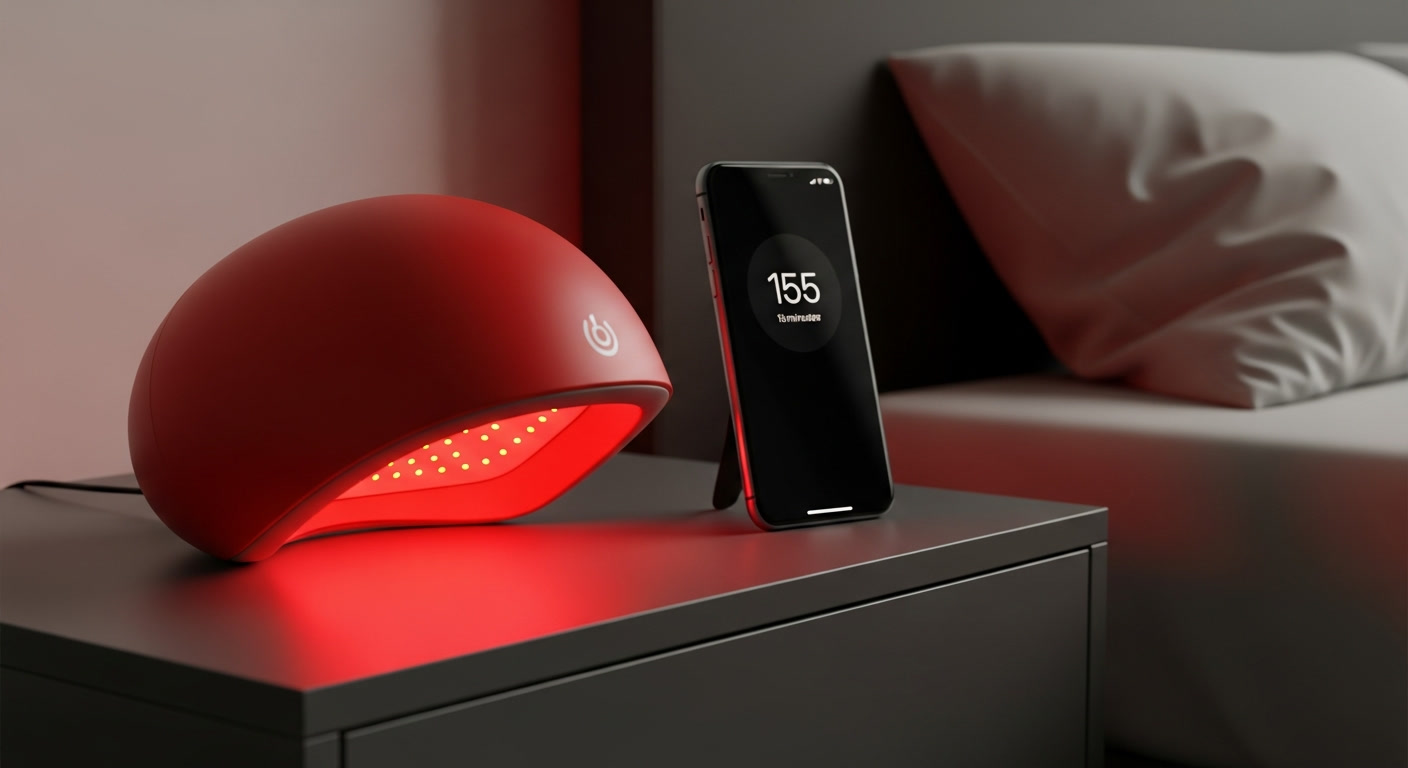
Track whether your laser cap is actually working
Six months of consistent photo tracking tells you more than any product review. BaldingAI gives you structured monthly comparisons so you can evaluate your laser cap investment with real data, not hope.
Use the BaldingAI hair tracking app to save one baseline session now, compare monthly checkpoints later, and keep one clear record for your next treatment or dermatologist decision.
Take one baseline session today. You cannot go back and capture last month, and the comparison you will want in three months only exists if today is in it.
What laser caps actually are
A laser cap is a wearable device shaped like a baseball cap or helmet lined with light sources that emit red or near-infrared wavelengths. Most target the 650 to 670 nanometer range, which is the wavelength band with the most clinical evidence for hair follicle stimulation. The technology behind them is called low-level laser therapy (LLLT), also known as photobiomodulation.
The typical protocol calls for 20 to 30 minutes of use every other day. You place the cap on your head, turn it on, and the diodes deliver light energy to your scalp. The major brands include iRestore, Capillus, HairMax LaserBand, and Theradome. Prices vary significantly based on one critical factor: whether the device uses actual laser diodes or LEDs. Basic LED-only models start around $200. Medical-grade devices with laser diodes run $500 to $800 or more.
The concept is not new. LLLT for hair has been studied since the early 2000s. What changed is the form factor. Earlier devices were handheld combs that required you to slowly move them across your scalp for 15 minutes. Caps solved the compliance problem by covering the entire scalp at once while you sit hands-free. That convenience is a genuine advantage. Whether the clinical results justify the price is a separate question.
The science: how light stimulates hair follicles
Photobiomodulation at the 650 to 670 nanometer wavelength targets a specific enzyme in the mitochondria called cytochrome c oxidase. When this enzyme absorbs red light photons, it triggers a cascade that increases adenosine triphosphate (ATP) production, the primary energy currency of cells. More ATP means higher cellular metabolism, which in hair follicle cells translates to extended time in the anagen (active growth) phase.
Avci et al. (2014) published a comprehensive review of LLLT mechanisms in Lasers in Surgery and Medicine. The review confirmed that photobiomodulation increases blood flow to treated tissue, reduces local inflammation, and upregulates growth factors including vascular endothelial growth factor (VEGF). In animal models, these effects extended the anagen phase and increased the percentage of follicles in active growth. The biological mechanism is real and well-characterized at the cellular level.
Wavelength matters. Red light in the 620 to 670 nanometer range has the strongest evidence for hair follicle stimulation. Near-infrared light (810 to 850 nanometers) penetrates deeper into tissue, but the hair-specific clinical data for near-infrared is thinner. Some devices combine both wavelengths. Whether the combination produces better results than red light alone has not been rigorously tested in hair-specific trials. The cellular mechanism is plausible, but plausible is not the same as proven.
What the clinical trials found
The two most cited clinical trials for laser hair devices both showed statistically significant results. But the size of those results needs context.
Jimenez et al. (2014) in the American Journal of Clinical Dermatology ran a randomized, sham-controlled trial of the HairMax LaserComb. After 26 weeks, the treatment group showed a statistically significant increase in hair density compared to the sham device group. The study was well-designed with a proper sham control, which is important because many laser device studies lack adequate blinding.
Kim et al. (2013) in Lasers in Medical Science tested a helmet-type LLLT device in a randomized, double-blind, sham-controlled trial. At 24 weeks, the treatment group saw an increase of 17.2 hairs per square centimeter compared to the sham group. Again, statistically significant.
Here is where context matters. An increase of 17 hairs per square centimeter is a real, measurable result. But it is modest. For comparison, minoxidil 5% in controlled trials typically achieves increases of 20 to 30 hairs per square centimeter. Finasteride delivers similar or higher numbers. Laser therapy, on the available data, produces roughly half to two-thirds the density improvement of established pharmaceutical treatments.
Both studies were funded by the device manufacturers, which is standard for medical device trials but worth noting. The sample sizes were relatively small (under 150 participants each). No long-term studies beyond 26 weeks have been published with at-home cap devices. The evidence is positive but limited in scope and duration.
FDA clearance vs FDA approval: an important distinction
Many laser cap brands market their products as "FDA-cleared," and some go further and call them "FDA-approved." These terms mean very different things, and the difference matters for your purchasing decision.
FDA clearance comes through the 510(k) pathway. This process requires the manufacturer to demonstrate that their device is "substantially equivalent" to a device already legally marketed in the United States. It does not require proof that the device is effective. It requires proof that it is safe and similar to existing cleared devices. The bar is lower than most consumers realize.
FDA approval, by contrast, requires clinical trial data demonstrating both safety and efficacy. This is the standard that drugs like finasteride and minoxidil had to meet. No at-home laser cap has gone through the full FDA approval process. When a brand says "FDA-approved," that is technically inaccurate. The correct term is "FDA-cleared," and the clearance confirms the device is safe, not that it works as advertised.
This does not mean laser caps are ineffective. It means the regulatory status tells you less than the marketing implies. Evaluate the clinical trial data on its own merits rather than treating the FDA clearance label as a stamp of proven efficacy.
Laser diodes vs LEDs: does the light source matter?
This is the single most important hardware distinction when comparing devices, and most marketing materials gloss over it.
Laser diodes produce coherent, focused light. The photons travel in a tight, organized beam that delivers concentrated energy to a specific point on the scalp. LEDs produce incoherent, diffuse light. The photons scatter in all directions, resulting in lower energy density at any given point on the scalp surface.
The clinical studies that demonstrated hair density improvements used laser diodes, not LEDs. This is a critical detail. When a brand cites the Jimenez or Kim trials as evidence for their LED-based cap, that is a misapplication of the data. The energy delivery profile of an LED array is fundamentally different from a laser diode array, and the clinical results from one cannot be assumed to apply to the other.
If you are considering a purchase, verify whether the device uses laser diodes (medical-grade, higher price point) or LEDs (consumer-grade, lower price point). Some devices use a combination of both. As a general rule, the price difference between a $200 cap and an $800 cap reflects this distinction. Cheaper devices are almost always LED-only. Whether LEDs deliver sufficient energy density to produce meaningful follicle stimulation has not been proven in rigorous clinical trials.
Who benefits most from laser caps
Laser caps are not for everyone. The clinical data and dermatological consensus point to a specific profile of people most likely to see results.
Best candidates: people with early-stage thinning (Norwood 2 to 3 for men, Ludwig I to II for women). At these stages, miniaturized follicles still have viable dermal papillae that can respond to stimulation. People using laser caps as an adjunct to finasteride or minoxidil rather than a standalone replacement tend to report the best outcomes. The mechanisms are complementary: finasteride reduces DHT, minoxidil improves blood flow, and LLLT boosts cellular energy production. Consistency also matters. People who commit to the every-other-day protocol for the full six months are the ones who appear in the positive outcome data.
Worst candidates: anyone with advanced hair loss (Norwood 5 and above) where follicles have been miniaturized beyond recovery. No amount of light energy will revive a follicle that has been dormant for years. People who expect dramatic, standalone regrowth from laser alone are setting themselves up for disappointment. And people who cannot commit to 20 to 30 minutes every other day for six or more months will not get enough cumulative exposure to see results. Sporadic use produces sporadic data, which produces no useful conclusions.
The honest framing: laser caps work best as one component of a multi-treatment approach for early-stage hair loss. They are not a replacement for finasteride or minoxidil. They may provide an incremental benefit on top of those treatments for people who want to maximize every available avenue.
How to evaluate whether your cap is working
The evaluation protocol for a laser cap is the same as any hair loss treatment. Monthly photos under consistent conditions, compared against your baseline at a hard six-month decision point. The difference is that with a $500+ device, you owe it to yourself to be especially rigorous about this process.
Before your first session, take comprehensive baseline photos. Capture your hairline from the front, both temples at 45-degree angles, the crown from directly above, and a side profile. Use consistent lighting. Wet or freshly towel-dried hair is better for density comparisons because styled dry hair hides scalp visibility. Record the date, your current treatment stack, and any medications you are taking.
Track your session compliance. Log every time you use the device and for how long. This is not optional. If you use the cap three times a week instead of the recommended four, your results will reflect that lower dose. At the six-month mark, you need to know whether you gave the device a fair trial. If your compliance was below 80% of recommended sessions, your negative result may reflect inconsistent use rather than device inefficacy.
At six months, compare your current photos directly against your day-one baseline. Not against last month. Not against a photo from three months in. Against the starting point. Look at overall density, hairline position, crown coverage, and part width. If you see stable or improved density with greater than 80% compliance, the device is contributing something positive. Continue the protocol and keep tracking.
If your six-month photos show continued thinning despite consistent use, do not extend the trial indefinitely. The clinical studies that found positive results saw them within 24 to 26 weeks. There is no evidence that laser caps have a delayed response beyond that window. If six months of consistent use has not produced visible improvement, the device is not working for your specific pattern and severity of hair loss.
Set the deadline before you start. Write it down. Decide in advance what "working" looks like for you and commit to an honest evaluation at the six-month mark. This protects you from the sunk cost fallacy, where the money you already spent on the device makes you keep using it long past the point where the data says it is not helping. Your photos are the evidence. Trust them over your hopes.
The bottom line on laser caps
Laser caps have real science behind them. The photobiomodulation mechanism is established, and the clinical trials show statistically significant hair density improvements. But "statistically significant" and "life-changing" are not the same thing. The improvements are modest, roughly half of what minoxidil or finasteride deliver. The best-quality evidence comes from laser diode devices, not the cheaper LED models. And FDA clearance confirms safety, not efficacy.
If you have early-stage thinning, are already on a pharmaceutical treatment, and want to add another tool, a medical-grade laser cap is a reasonable addition. If you are looking for a standalone solution, the evidence suggests you will be disappointed. And if your hair loss is advanced, no amount of light therapy will reverse years of follicular miniaturization.
Whatever you decide, track it. A $200 to $800 purchase deserves the same rigorous evaluation you would give any medical treatment. Take baseline photos, log your compliance, and compare honestly at six months. The data will tell you whether your laser cap earned its price tag or whether that money would have been better spent on a dermatology consultation.
What this guide helps you decide
Evaluate at-home laser cap claims against clinical evidence and decide if it's worth the investment
Best for readers comparing options and trying to keep the same evidence standard across choices.
Use This Guide Well
For buyer education content, decision quality improves when comparison criteria are measurable and tied to a consistent tracking protocol.
- Compare options using decision criteria you can actually track over months.
- Define your escalation trigger before uncertainty spikes.
- Bring timeline data to clinician conversations so choices are evidence-based.
Safety note
This article is for education and tracking guidance. It does not replace diagnosis or treatment advice from a licensed clinician.
- Use matched photo conditions whenever possible.
- Review monthly trends instead of reacting to one photo day.
- Escalate persistent uncertainty or symptoms to clinician care.
Questions and Source Notes
Know when to escalate with structured evidence, not panic
Use Balding AI and our planning tools to organize your notes, checkpoints, and next-step questions before you change the plan or book the next visit.


Keep Reading From Here
Continue with the next article or matching tracking route that keeps this guide actionable instead of sending you back into broad browsing.
Next editorial reads
Caffeine Shampoo for Hair Loss: Does It Work?
Foundational Guide · consideration
Saw Palmetto for Hair Loss: Does It Actually Work?
Foundational Guide · consideration
Does Biotin Help Hair Loss? What Research Shows
Foundational Guide · consideration
Natural DHT Blockers for Hair Loss: What Actually Works?
Foundational Guide · consideration