
FUE vs FUT Hair Transplant: Which Is Better for You?
Written by the Balding AI Editorial Team, medically reviewed by Dr. Kenji Tanaka (Trichologist), grounded in AAD and NHS clinical guidelines. Tracking guidance, not medical advice or diagnosis.
Jump to sections
If you've decided a hair transplant is the right move, the next question is which technique: FUE or FUT. Both have been performed for decades, both produce real hair growth in the recipient area, and both have passionate advocates online who insist their preferred method is categorically superior. The reality is more nuanced. FUE and FUT differ in how grafts are harvested, what kind of scarring they leave, how much they cost, and how long recovery takes. But the final hair growth result, when performed by a skilled surgeon, is essentially the same. The right choice depends on your specific hair loss pattern, your budget, your hairstyle preferences, and how many grafts you need. This guide breaks down every meaningful difference so you can make that decision with data instead of forum hype.
Track your transplant recovery from day one
BaldingAI helps you document donor healing, recipient growth, and monthly density changes with structured photo comparisons so you and your surgeon can evaluate progress objectively.
Use the BaldingAI hair tracking app to save one baseline session now, compare monthly checkpoints later, and keep one clear record for your next treatment or dermatologist decision.
Take one baseline session today. You cannot go back and capture last month, and the comparison you will want in three months only exists if today is in it.
FUE vs FUT: the fundamental difference
Both FUE and FUT accomplish the same goal: moving hair follicles from the DHT-resistant donor area at the back and sides of your head to the thinning or balding recipient area. The difference is entirely in how those follicles are harvested from the donor zone.
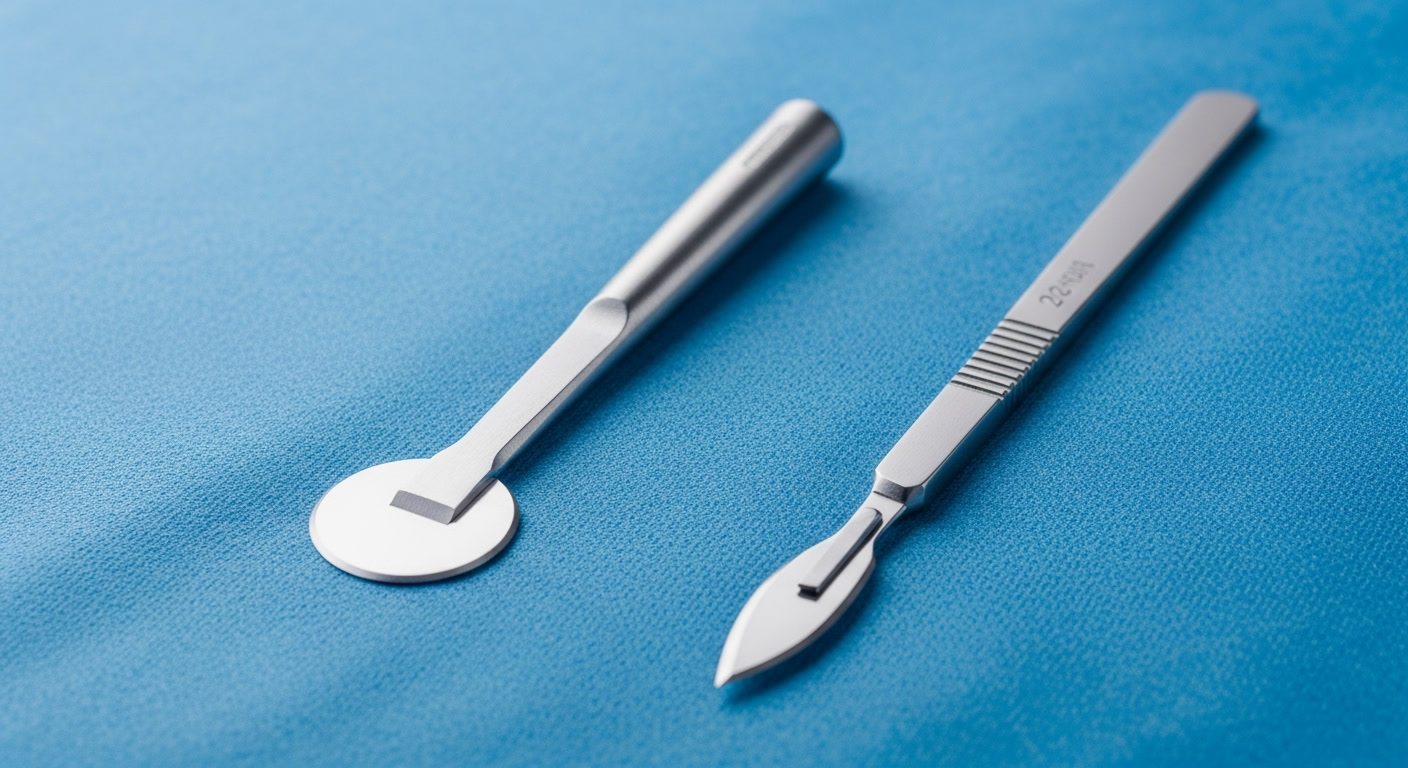
FUT (Follicular Unit Transplantation), also called the strip method, involves removing a narrow strip of scalp from the donor area, typically 1 to 1.5 cm wide and 15 to 30 cm long depending on how many grafts are needed. That strip is taken to a dissection station where a team of technicians separates it into individual follicular units under stereoscopic microscopes. Each follicular unit contains 1 to 4 hairs. The donor wound is then closed with sutures or staples, leaving a single linear scar.
FUE (Follicular Unit Extraction) skips the strip entirely. Instead, individual follicular units are extracted one at a time directly from the donor area using a small cylindrical punch tool, typically 0.8 to 1.0 mm in diameter. The punch scores around each follicular unit, which is then pulled out with forceps. This leaves a small circular wound for each extracted graft. No sutures are needed because the individual wounds are small enough to heal on their own.
Once the grafts are harvested by either method, the implantation process is identical. The surgeon creates tiny recipient sites in the balding area using needles or blades, then the grafts are placed into those sites at the correct angle, direction, and density. The final hair growth comes from the implanted follicles, which behave the same regardless of how they were harvested.
Graft survival rates
This is the question that matters most, and the answer is reassuring: both techniques produce equivalent graft survival when performed by experienced surgeons. Dua and Dua published a comparative study in Dermatologic Surgery (2010) showing no statistically significant difference in graft survival rates between FUE and FUT. Both methods achieved survival rates in the 90 to 95% range when the surgeon had significant experience with the technique.
A separate systematic review by Rose and Nusbaum in Dermatologic Surgery (2014) confirmed these findings across multiple studies. The consistent conclusion: surgeon skill and experience are far stronger predictors of graft survival than the extraction method. A surgeon who performs 200 FUE procedures per year will produce better FUE results than one who does 20. The same applies to FUT.
Where the techniques can diverge is in the transection rate, which is the percentage of grafts damaged during extraction. FUT has a natural advantage here because grafts are dissected from the strip under direct microscopic visualization. The technician can see the follicle orientation and cut precisely around it. FUE extraction is performed "blind" in the sense that the punch is guided by the surface angle of the hair shaft, but the follicle direction beneath the skin can differ slightly. In less experienced hands, FUE transection rates can reach 5 to 10%, while skilled FUE surgeons keep it below 3%. FUT transection rates are typically 1 to 2% with experienced dissection teams.
The practical takeaway: if you choose a surgeon with strong experience in their technique, the graft survival difference between FUE and FUT is negligible. The surgeon matters more than the method.
Scarring comparison
Neither FUE nor FUT is truly scarless. Both leave permanent marks in the donor area. The question is what type of scarring fits your lifestyle and hairstyle preferences.
FUT scarring: One linear scar running horizontally across the back of the head. When healed and closed well, this scar is typically 1 to 3 mm wide. With a trichophytic closure technique, where one wound edge is trimmed to allow hair to grow through the scar, the line can become very difficult to detect at hair lengths of a #3 guard (about 10 mm) or longer. Below a #3, the scar becomes visible. If you ever want to shave your head or wear a very short buzz cut, the FUT scar will be noticeable. Scar revision surgery can narrow a wide scar, and scalp micropigmentation (SMP) can camouflage it, but neither eliminates it entirely.
FUE scarring: Hundreds to thousands of tiny circular scars, each 0.8 to 1.0 mm in diameter, scattered across the donor area. Individually, these dots are very hard to see. Collectively, however, they can create a subtle change in donor area appearance. If a surgeon extracts too aggressively from one zone, or if the total extraction count is very high across multiple sessions, the donor area can develop a slightly thin or "moth-eaten" appearance. This is especially visible if you shave the donor area very short (below a #2 guard). At moderate hair lengths, FUE scars are essentially invisible to casual observation.
The scarring difference is the single biggest factor driving most patients toward FUE. If you currently wear your hair short or plan to in the future, FUE gives you more flexibility. If you always wear your hair at medium to long lengths and a linear scar at the back of your head would never be exposed, the FUT scar is largely a non-issue.
Cost comparison
FUE is almost always more expensive than FUT. The reason is straightforward: FUE takes longer. Extracting 2,000 individual follicular units one at a time requires more surgeon hours than removing a strip and having a team dissect it.
FUE pricing: Typically $4 to $10 per graft in the US, depending on the surgeon and geography. For a 2,000-graft procedure, that puts the total between $8,000 and $20,000. High-demand surgeons in major metropolitan areas charge at the upper end. Some elite surgeons price FUE sessions above $10 per graft.
FUT pricing: Typically $3 to $7 per graft. For the same 2,000 grafts, the total ranges from $6,000 to $14,000. The cost savings come from the efficiency of strip dissection. A team of 3 to 4 technicians can dissect a strip into 2,000 grafts faster than a single surgeon can extract 2,000 individual FUE grafts.
For context, most first-time transplant patients need between 1,500 and 3,000 grafts. At the higher end of that range, the price difference between FUE and FUT can be $5,000 to $10,000 for the same graft count. That premium buys you the absence of a linear scar. Whether that trade-off makes sense depends on how you wear your hair and what your budget allows. Neither technique produces better hair growth for the money. You are paying for a different donor-area outcome, not a different recipient-area outcome.
Recovery timeline
Recovery splits into two zones: the donor area (where grafts came from) and the recipient area (where they were placed). The recipient area recovery is identical for both techniques. The donor area is where they differ.
FUT donor recovery: Staples or sutures are removed at 10 to 14 days post-op. Most patients report moderate tightness and discomfort along the incision line for the first week, managed with prescribed pain medication. The scar takes 2 to 3 weeks to close fully and 3 to 6 months to fade to its final appearance. Numbness behind and around the scar is common and can persist for 3 to 6 months before nerve sensation returns. Return to exercise is typically 2 to 3 weeks, though heavy lifting and contact sports should wait 4 weeks to avoid tension on the healing incision.
FUE donor recovery: The small punch wounds typically scab over within 3 to 5 days and heal fully in 7 to 10 days. Post-op pain is generally milder because no large incision was made. Most patients describe mild soreness rather than the tightness associated with FUT. Return to light exercise is often possible at 7 to 10 days, and full activity at 2 weeks. Numbness is rare because the extraction wounds are superficial compared to a strip incision.
Recipient area recovery (same for both): Tiny scabs form around each implanted graft and fall off between day 7 and day 14. The recipient area looks red and slightly swollen for the first week, then settles. Shock loss, where most transplanted hair shafts fall out while the follicle remains alive beneath the skin, occurs between weeks 2 and 8. New growth begins at month 3 to 4, reaches roughly 50% density by month 6, and achieves the full result between months 12 and 18.
Who should choose FUE
FUE is the stronger choice for specific patient profiles. If several of these apply to you, FUE is likely the better fit.
You wear your hair very short. If you currently keep a buzz cut, a skin fade, or any style shorter than a #3 guard, a FUT scar will be visible. FUE dot scars are far less conspicuous at short lengths. This is the most clear-cut reason to choose FUE.
You want to keep future procedures open. If you are younger and anticipate needing additional transplant sessions as your loss progresses, FUE allows you to distribute extraction across the entire donor area over time. FUT can be repeated, but each additional strip procedure makes the next closure slightly tighter and the scar slightly wider.
You have a tight scalp with low laxity. Scalp laxity is how much the skin stretches. FUT requires enough laxity to remove a strip and close the wound without excessive tension. If your scalp is tight, the resulting scar may be wider, or the surgeon may not be able to harvest as many grafts. FUE bypasses this limitation entirely because no strip is removed.
You prioritize faster recovery. If minimizing downtime matters, FUE's shorter donor healing period (7 to 10 days vs 2 to 3 weeks) and lower post-op discomfort can be meaningful advantages. Some patients return to work within 5 days after FUE with a hat covering the recipient area.
You are willing to pay the premium. FUE costs more. If the extra $3,000 to $8,000 for scar-free donor healing fits your budget without strain, the cosmetic benefit to the donor area is a legitimate advantage.
Who should choose FUT
FUT has genuine advantages that make it the better choice for certain patients. If several of these apply to you, FUT deserves serious consideration.
You need maximum grafts in one session. FUT consistently yields higher graft counts per session. A single FUT procedure can harvest 3,000 to 4,000+ grafts, while FUE sessions typically top out at 2,000 to 3,000 grafts due to the time-intensive extraction process. If you are Norwood 4 or higher and need comprehensive coverage, FUT can accomplish in one session what FUE might require two sessions to match.
Your budget is a primary concern. At $3 to $7 per graft versus $4 to $10 per graft, FUT saves meaningful money at higher graft counts. For a 3,000-graft procedure, the difference could be $6,000 or more. That savings can fund additional treatments like PRP, medication, or a future touch-up procedure.
You wear your hair at medium or long lengths. If your hair is always long enough to cover the donor area, the linear scar is invisible in your daily life. Many FUT patients forget the scar exists because they never see it and no one else does either.
You want to preserve maximum donor density. FUT removes a strip from one zone, leaving the rest of the donor area untouched. FUE, by contrast, extracts grafts from across the entire donor zone, which can subtly reduce overall donor density. If you anticipate needing your donor area to look as full as possible for the long term, FUT concentrates the impact in one easily hidden line rather than distributing it across the whole area.
You prioritize graft integrity. Because FUT grafts are dissected under direct microscopic visualization, the transection rate is typically lower. Rassman et al. in the International Journal of Trichology (2012) noted that strip dissection allows the technician to follow the natural curve of the follicle, reducing damage. For patients who want every possible graft to survive, FUT offers a slight theoretical advantage in graft quality.
How to track transplant recovery
Regardless of which technique you choose, structured tracking during recovery makes the experience less stressful and gives your surgeon better data at follow-up appointments. The recovery timeline is identical for the recipient area, and the psychological challenge of waiting for growth is the same for both FUE and FUT patients.
Establish your baseline immediately. Take photos of both the donor and recipient areas on the day of surgery, before any bandaging. Use consistent lighting, the same angles every time, and clean hair (dry, not styled). You need at minimum four angles for the recipient area (front, both temples, top-down for the crown) and two for the donor area (back center and both sides).
Weekly photos for the first 8 weeks. This covers the acute healing phase and shock loss period. The weekly cadence documents the progression of scab shedding, redness reduction, and the onset of shock loss. These photos will look discouraging. That is normal. Their purpose is to create a reference point you can look back on at month 6 when the growth is coming in and you want to see how far you have come.
Monthly photos from month 3 onward. Month 3 is typically when the first new hairs begin emerging. From this point forward, monthly comparison photos become genuinely informative. Compare each month to the same angle from the previous month and to your pre-op baseline. By month 6, you should see visible improvement. By month 9, the trajectory should be clearly positive. If month 6 shows no visible growth at all, that warrants a conversation with your surgeon.
Log complications and observations. Track any signs of infection (unusual redness, swelling, discharge), numbness, cyst formation around implanted grafts, or ingrown hairs. Note when numbness resolves, when the last scabs fell off, and when you first noticed new growth. This log is valuable for your surgeon and useful context if you ever consider a second procedure.
Your 12-month photo vs baseline tells the full story. The final assessment comes at month 12 to 18. Set your month-12 photo next to your pre-op baseline under the same lighting and angle. That comparison is the objective measure of your transplant outcome. It is also the data point that determines whether a touch-up session makes sense, whether your surgeon delivered on the plan, and whether you are satisfied with the result. Everything before month 12 is progress tracking. Month 12 is the verdict.
What this guide helps you decide
Choose between FUE and FUT based on your specific situation and track transplant recovery
Best for readers who need one cleaner next step instead of another round of anxious comparison.
Use This Guide Well
For buyer education content, decision quality improves when comparison criteria are measurable and tied to a consistent tracking protocol.
- Use one primary metric set for all options you evaluate.
- Avoid switching frameworks mid-cycle, or your comparisons lose reliability.
- Commit to a checkpoint window and decide from trend direction, not one photo.
Safety note
This article is for education and tracking guidance. It does not replace diagnosis or treatment advice from a licensed clinician.
- Use matched photo conditions whenever possible.
- Review monthly trends instead of reacting to one photo day.
- Escalate persistent uncertainty or symptoms to clinician care.
Questions and Source Notes
Pick one path, then track it with discipline
Balding AI gives you consistent captures, monthly checkpoints, and a clearer review rhythm so your choice holds up in real life, not just in theory.


Keep Reading From Here
Continue with the next article or matching tracking route that keeps this guide actionable instead of sending you back into broad browsing.
Next editorial reads
Hair Loss Treatment Costs Over 5 Years: Real Total Spend
Decision Framework · decision
Hair Loss Treatment Costs: 2026 Price Guide
Decision Framework · decision
Finasteride vs Dutasteride: A Tracking-First Decision Framework
Decision Framework · decision
When to Consider a Hair Transplant: The Decision Framework
Foundational Guide · decision